Loading content...
Index
138
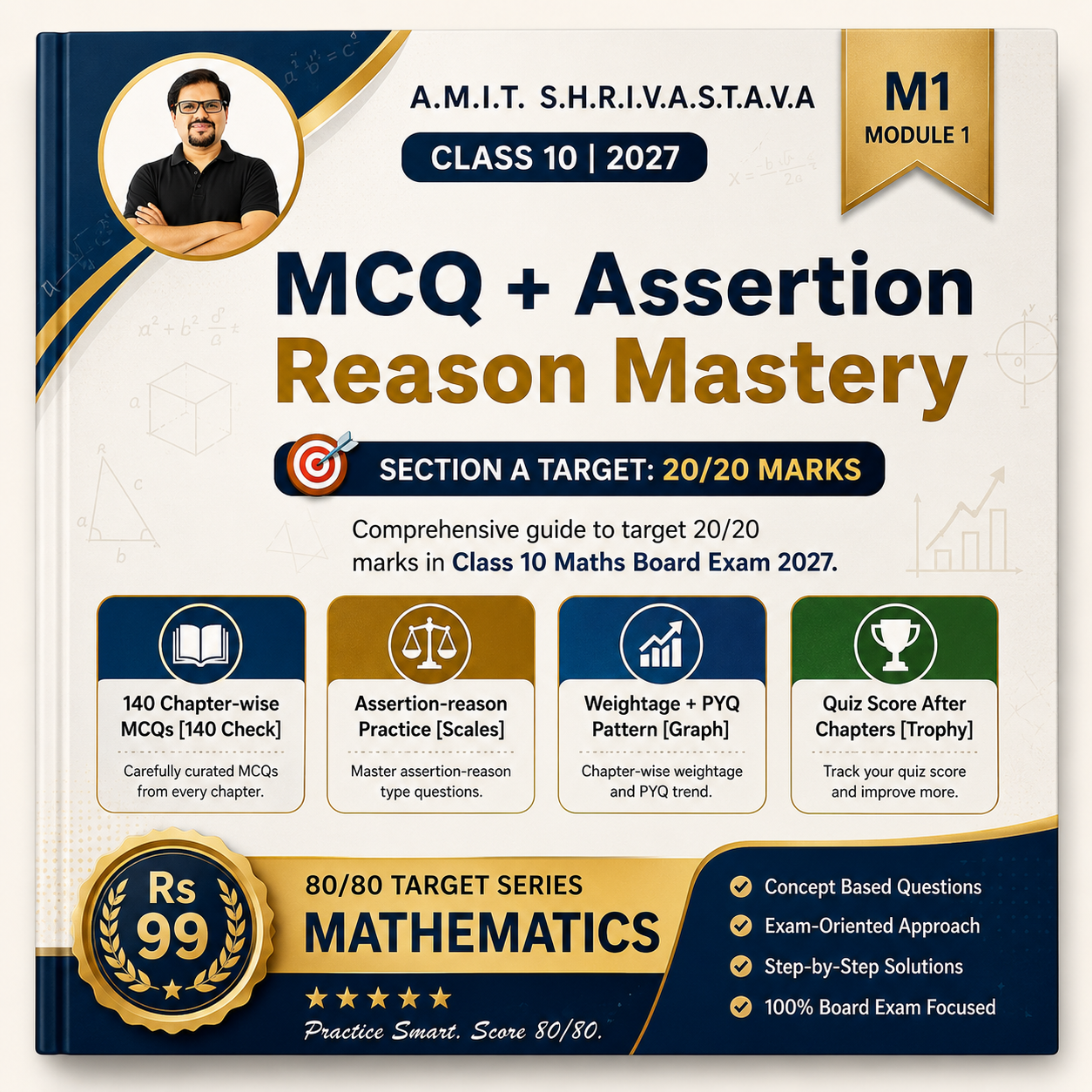
MCQs
14
Chapters
3
Papers
Chapter-wise weighted practice
PYQ-pattern and board-trend MCQs
Chapter quiz with score tracking
Real Numbers
MCQ practice, detailed solution, chapter-end quiz
Polynomials
MCQ practice, detailed solution, chapter-end quiz
Pair of Linear Equations
MCQ practice, detailed solution, chapter-end quiz
Quadratic Equations
MCQ practice, detailed solution, chapter-end quiz
Arithmetic Progressions
MCQ practice, detailed solution, chapter-end quiz
Triangles
MCQ practice, detailed solution, chapter-end quiz
Coordinate Geometry
MCQ practice, detailed solution, chapter-end quiz
Introduction to Trigonometry
MCQ practice, detailed solution, chapter-end quiz
Applications of Trigonometry
MCQ practice, detailed solution, chapter-end quiz
Circles
MCQ practice, detailed solution, chapter-end quiz
Areas Related to Circles
MCQ practice, detailed solution, chapter-end quiz
Surface Areas and Volumes
MCQ practice, detailed solution, chapter-end quiz
Statistics
MCQ practice, detailed solution, chapter-end quiz
Probability
MCQ practice, detailed solution, chapter-end quiz
3 Section A sample papers, 18 MCQs each, with answer key and score analysis for final exam confidence.
MCQ + Assertion Reasoning Book
Page 1
This Real Numbers preview covers prime factorisation, HCF-LCM applications and irrationality. The 2026-27 CBSE syllabus lists the Fundamental Theorem of Arithmetic and proofs that the square roots of 2, 3 and 5 are irrational. Euclid's algorithm and decimal expansions below are additional foundation revision, not separately listed topics in the current Real Numbers syllabus.
Fundamental Theorem of Arithmetic: every composite positive integer has a prime factorisation that is unique apart from the order of its factors. For positive integers a and b, HCF(a,b) times LCM(a,b) equals ab. Use the smallest prime powers for HCF and the largest for LCM.
Irrationality proof template: let p be 2, 3 or 5, each of which is prime. Suppose for positive coprime integers a,b. Then , so p divides a. Write . Substitution gives , so p also divides b. This contradicts coprimality. Therefore , and are irrational.
Application: if were rational, subtracting 3 and dividing by 2 would make rational, contradicting the proof above. Thus is irrational.
Decimal expansion revision: first reduce a rational number to a fraction with a positive denominator. Its decimal terminates exactly when that denominator is with non-negative integers m,n; a denominator of 1 is included.
Preview: 11 worked questions and 4 self-check questions
Practice style: concept MCQ, calculation MCQ and assertion-reason
Concept focus: prime factorisation, HCF-LCM, irrationality and decimal expansion
Attempt rule: solve first, then check solution direction
MCQ + Assertion Reasoning Book
Page 2
Q1. For positive integers and , Euclid's division lemma states that . Which condition is correct for ?
Q2. The HCF of and is:
Q3. If , then is:
Accuracy checkpoint: If Q2 is wrong, revise Euclid's division algorithm.
Speed checkpoint: Q3 should take less than 45 seconds.
MCQ + Assertion Reasoning Book
Page 3
Q4. The prime factorisation of is:
Q5. Which statement must hold for every prime and integers ?
Q6. Which of the following is irrational?
Proof checkpoint: practise the coprime-integers contradiction for , and .
Common trap: is rational because it is in form.
MCQ + Assertion Reasoning Book
Page 4
Q7. The decimal expansion of is:
Q8. The decimal expansion of is:
Q9. A rational number is written in simplest form with positive denominator q. Which condition is necessary and sufficient for its decimal expansion to terminate?
Formula memory: Terminating decimal denominator = after simplification.
Mistake alert: Always reduce the fraction to simplest form first.
MCQ + Assertion Reasoning Book
Page 5
Q10. Assertion: The number can never end with digit for any positive integer . Reason: Any positive integer ending with must have as a prime factor.
A. Both Assertion and Reason are true, and Reason is the correct explanation. B. Both Assertion and Reason are true, but Reason is not the correct explanation. C. Assertion is true, Reason is false. D. Assertion is false, Reason is true.Q11. Assertion: HCF of two different prime numbers is always . Reason: Prime numbers have only two factors, and the number itself.
A. Both Assertion and Reason are true, and Reason is the correct explanation. B. Both Assertion and Reason are true, but Reason is not the correct explanation. C. Assertion is true, Reason is false. D. Assertion is false, Reason is true.Assertion-reason rule: Check Assertion independently, then Reason independently, then connection.
Exam habit: Do not select option A unless the reason actually explains the assertion.
MCQ + Assertion Reasoning Book
Page 6
Mini Quiz: Attempt these without seeing the solution. Give yourself 8 minutes.
Q12. is:
Q13. LCM of and is:
Q14. Decimal expansion of is:
Q15. Which number is irrational?
Solutions: Q12: and , so HCF is 13. Q13: and , so LCM is 36. Q14: and the fraction is reduced, so the decimal terminates. Q15: is not a perfect square, so is irrational.
Next chapter after this: Polynomials
Target before next chapter: zero confusion in HCF-LCM and decimal expansion
Pre-booking reserves full access at launch. Only the preview is available today; the expected launch is 28 October 2026.