Class 10 Science
Build chapter confidence with fresh questions before moving to exam-focused revision.
Why use practice questions?
Practice Questions help you learn and correct a topic through repeated attempts and explanations. Use Important Questions for priority revision, PYQs for past-board patterns, and Competency Questions for new application situations.
Notes, formulae and solved examples Practice coverage: 35 published questions across 6 formats in physics.
Maths Science Phy Chem Bio
Chapter All chapters Light: Reflection and Refraction The Human Eye and the Colourful World Electricity Magnetic Effects of Electric Current Topic All topics Spherical Mirrors Refraction Lenses Human Eye Defects of Vision Dispersion of Light Ohm's Law Resistance Electric Power Magnetic Field Force on a Current-Carrying Conductor Electric Motor and Generator
MCQs A-R VSA SA LA Case Study
Base: Build concepts Focus: Apply with confidence
A. Potential difference B. Resistance C. Temperature D. Length only Select an option first. The solution will unlock after your attempt.
What does Ohm's law state?
It states that V = I R
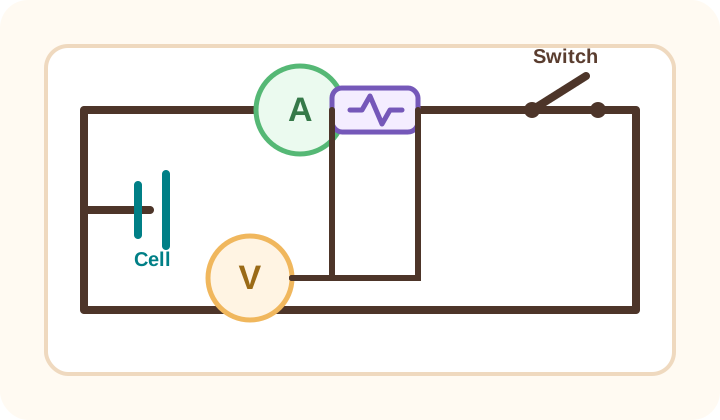
Ohm's law circuit diagram showing ammeter in series and voltmeter in parallel. A. In series with the resistor B. In parallel with the resistor C. Only with the switch D. Directly across the ammeter Select an option first. The solution will unlock after your attempt.
How is a voltmeter connected in a circuit?
A voltmeter is connected in parallel across the component whose potential difference is measured.
A. Volt B. Ampere C. Ohm D. Watt Select an option first. The solution will unlock after your attempt.
What is the SI unit of electric current?
The SI unit of electric current is ampere.
A. V = Q W B. V = W Q C. V = W Q D. V = I R 2 Select an option first. The solution will unlock after your attempt.
What is potential difference?
It is work done per unit charge.
A. Ampere B. Volt C. Ohm D. Coulomb Select an option first. The solution will unlock after your attempt.
What is the SI unit of resistance?
Resistance is measured in ohm.
A. R = R 1 + R 2 + R 3 B. R 1 = R 1 1 + R 2 1 C. R = R 1 + R 2 R 1 R 2 D. R = 0 Select an option first. The solution will unlock after your attempt.
How is equivalent resistance found in series?
Add all resistances directly.
A. R = R 1 + R 2 B. R 1 = R 1 1 + R 2 1 C. R = R 1 − R 2 D. R = R 1 R 2 Select an option first. The solution will unlock after your attempt.
What is the formula for parallel resistance?
R 1 = R 1 1 + R 2 1
A. H = I 2 R t B. H = I R C. H = I V D. H = P t 2 Select an option first. The solution will unlock after your attempt.
What is Joule's law of heating?
Heat produced is H = I 2 R t
A. P = V I B. P = V I C. P = V R D. P = I + R Select an option first. The solution will unlock after your attempt.
What is electric power formula?
Electric power is P = V I
A. South to North B. North to South C. Centre to edges D. Only in circles Select an option first. The solution will unlock after your attempt.
Do magnetic field lines intersect?
No, magnetic field lines never intersect.
A. Magnetic field B. Current C. Force D. Resistance Select an option first. The solution will unlock after your attempt.
What do curled fingers show?
They show the direction of magnetic field lines.
A. Induced current B. Magnetic field only C. Force on current-carrying conductor D. Resistance Select an option first. The solution will unlock after your attempt.
Which device uses motor effect?
Electric motor uses motor effect.
A. Magnetic field linked with circuit changes B. Resistance is zero C. Switch is always open D. Wire is at rest with no field change Select an option first. The solution will unlock after your attempt.
What is electromagnetic induction?
It is production of current due to changing magnetic field.
A. i = r B. i > r C. i < r D. i + r = 9 0 ∘ Select an option first. The solution will unlock after your attempt.
Angles in reflection are measured from which line?
They are measured from the normal.
A. Away from normal B. Towards normal C. Along surface D. Backward always Select an option first. The solution will unlock after your attempt.
Why does light bend during refraction?
Because its speed changes when it enters another medium.
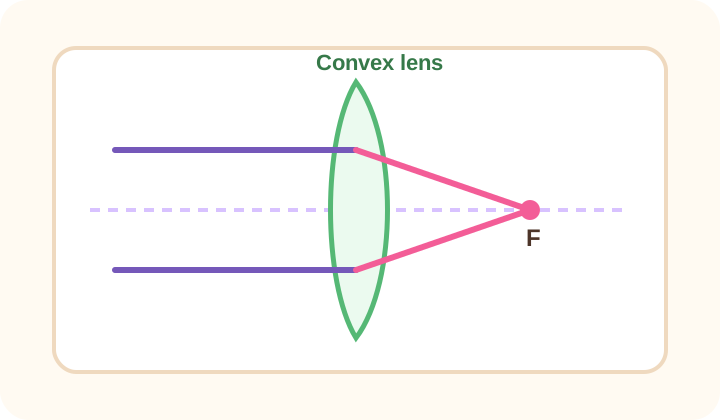
Convex lens ray diagram showing convergence of parallel rays at the focus. A. Optical centre B. Principal focus C. Pole D. Twice the focal length always Select an option first. The solution will unlock after your attempt.
What does a convex lens do to parallel rays?
It converges them at the principal focus.
A. Real and inverted B. Virtual, erect and diminished C. Real and enlarged D. Always same size Select an option first. The solution will unlock after your attempt.
Is image by concave lens obtained on screen?
No, it is generally virtual and cannot be obtained on a screen.
A. f 1 = v 1 + u 1 B. f = u + v C. u 1 = f + v D. v = u f Select an option first. The solution will unlock after your attempt.
What quantities are used in mirror formula?
Focal length f v u
A. Cornea B. Retina C. Iris D. Pupil Select an option first. The solution will unlock after your attempt.
Where is image formed in human eye?
Image is formed on the retina.
A. Reflection B. Dispersion C. Scattering D. Accommodation Select an option first. The solution will unlock after your attempt.
What is dispersion of light?
It is splitting of white light into its component colours.